
By Bhaskar Lahiri, Adi Sanaskar | Reviewed by Senior purohit : Nimai Mukherjee | Last updated: November 2026

A purohit training school teaches you three things: how to chant mantras correctly, the order in which a ritual runs, and how to conduct a puja for a real family. A good one also lets you practise beside a working purohit before you lead a puja alone.
This guide explains what a good purohit training school should teach, how the different ways of learning compare, and what a certificate is and isn’t worth. It also walks through the course, fees and admission process at Adi Sanaskar. Because we run a purohit training school near Kolkata, we’ve added a checklist you can use on any school, including ours.
Key facts about the Adi Sanaskar purohit training school
| Detail | Adi Sanaskar course |
|---|---|
| Levels | Adi Pujari (3 months), Adi Purohit (9 months), Adi Acharya (18 months) |
| Language | Bengali |
| Learning modes | Online, offline, combo, or exclusively online / exclusively offline |
| Online classes | 100% live, not recorded lectures |
| Classes | Two a week |
| Fees | ₹5,999 to ₹19,999, with instalments; 50% off for women |
| Certificate | Adi Sanaskar certificate with a QR verification code (not government-recognised) |
| Offline venue | South 24 Parganas, near Kolkata |
| Contact | WhatsApp +91 85839 37114 |
What does a purohit training school actually teach?
It teaches you to carry out a ritual correctly from start to finish, and that takes more than reading mantras aloud.
Take a family Lakshmi puja. Before the first mantra comes shuddhi (purification), achaman, sankalpa (the resolve stating who is performing the puja and why) and ghata sthapana. Then the offerings follow in order, with the panchali, the aarti and the pushpanjali. However, a mantra recited perfectly in the wrong sequence still makes a poor puja. In other words, the sequence, the samagri and the timing are what separate a purohit from someone who has simply memorised verses.
A Kolkata example: the 2002 Purohit Paathshala
Priest training in Kolkata is not new. In October 2002, Hindu Press International reported on the Purohit Paathshala near Amherst Street. The first class had 35 students, who paid about $1 a month for a one-year course. They could choose a track for puja and deity worship, or a longer one that added mantras for weddings, thread ceremonies and funerals. One trainee, 40-year-old Narayan Shashtri, planned to assist a main purohit during Durga Puja and expected to earn about $16, plus clothes, grain, fruit and sweets. The numbers have changed since then, but the idea hasn’t: you learn the mantras first, and then you learn the work by assisting a senior purohit.
What are the different ways to learn purohit work in West Bengal?
There are four common routes, and each suits a different person.
| Route | How it works | Strength | Limitation |
|---|---|---|---|
| Family purohit or guru | Learn informally by assisting over the years | Deep, personal, tradition-rich | Slow and unstructured; you need a willing guru |
| Online-only recorded certificate | Recorded lessons and a multiple-choice exam | Cheap, flexible | Little feedback on pronunciation; no practice at real pujas |
| Institute or distance certificate | Classroom or correspondence course with an exam | A formal syllabus | Often generic, not Bengali-specific |
| Hybrid school with live teaching | Live classes, practice at real pujas, a mentor | Feedback plus practice | Fixed batch schedule; higher fees than recorded courses |
A hybrid purohit training school combines live teaching with supervised practice, so it comes closest to learning from a guru while still giving you structure. For example, one national online certificate lists a three-month Paurohitya course with a 30-question multiple-choice exam. That can test whether you know the theory, but it cannot tell anyone whether you can set up a ghata, pace a Satyanarayan puja or settle a nervous family.
So the right choice depends on your goal. If you only want to understand your own family’s rituals, a guru or an online certificate may be enough. However, if you want to conduct pujas for others, look for live teaching and supervised practice.
Which purohit training school is near me in Kolkata?
Adi Sanaskar teaches online and at an offline venue in South 24 Parganas, near Kolkata. We share the exact venue before each batch starts. You choose how to attend, at any of the three levels:
| Mode | How it works | Best for |
|---|---|---|
| Online | 100% live classes, interactive and in real time | Learners outside Kolkata, working people |
| Offline | In-person classes at the venue | People near Kolkata who prefer a classroom |
| Combo | A mix of live online and in-person classes | Those who want flexibility plus hands-on practice |
| Exclusively online or offline | A dedicated option if you want only one mode | Anyone with a fixed preference |

We hold two classes a week, which suits people who work or study. Because every online class is live, learners outside Bengal can also learn the Bengali way of puja from home. Real puja practice happens in person with a senior purohit, so if you choose an online-only mode, message us on WhatsApp and we will explain how the practice requirement fits your batch.
What is the purohit training syllabus?
The syllabus builds in three levels, so you can start from the beginning or enter higher if you already have experience.
Basic course – Adi Pujari: (3 months, 24 classes)
| Month | You learn |
|---|---|
| 1 | Shuddhi, achaman, asana shuddhi, pranayama, sankalpa, swastivachan; identifying puja samagri; ghata sthapana and alpona |
| 2 | Panchopachara and shodashopachara puja, dhyana, aarti, pushpanjali; Sanskrit mantra pronunciation; Ganesh and Lakshmi puja with panchali |
| 3 | Saraswati puja (anjali and hatekhori), Satyanarayan, Shashthi and Vishwakarma puja; a mock puja; dealing with the family you serve and dakshina etiquette |
Adi Purohit: diploma (9 months, 72 classes)
| Phase | You learn |
|---|---|
| Months 1 to 3 | Sanskrit mantras in depth, nityakarma, reading the panjika (tithi, nakshatra, auspicious timings), start of Gita path |
| Months 4 to 6 | Kali, Jagaddhatri, Shiva, Narayan, Manasa, Shani and Kartik puja; pat and ghata puja; simple homa |
| Months 7 to 9 | Griha pravesh, bhumi puja, shop and halkhata puja, annaprashan and naming ceremony; preparing samagri lists and setting dakshina |
Adi Acharya: advanced diploma (18 months, 144 classes)
The Adi Acharya diploma works as a Karma Kanda training course with certificate. It covers the full range of ritual, from Durga puja and homa to weddings and shraddha.
| Phase | You learn |
|---|---|
| Months 1 to 3 | Sanskrit grammar, tone and pronunciation of Vedic and Puranic mantras; the idea of karmakanda |
| Months 4 to 6 | The complete Bhagavad Gita path, all 18 chapters, with meaning |
| Months 7 to 9 | Chandi path and the full Durga puja vidhi from Shashthi to Dashami, including sandhi puja |
| Months 10 to 12 | Homa, yajna, kushandika, pran pratishtha and vastu puja |
| Months 13 to 15 | Upanayana and the Bengali wedding rites |
| Months 16 to 18 | Shraddha, tarpan and ashoucha rules under a guru’s supervision; muhurta selection; professional conduct; final exam |
The Gita months follow the same method as our Bhagavad Gita path course, and you can see how that teaching works in our 1-year Bhagavad Gita course in Bengali. For context on the last rites you study in months 16 to 18, read our guide to the 13th-day ritual.

What is karmakanda (karma kanda)?
Karmakanda, also written karma kanda, is the ritual portion of Vedic and Hindu tradition: the rules for performing actions such as pujas, homas and samskaras. Tradition usually divides it into nitya (daily duties), naimittika (occasional, triggered by an event such as a birth or a festival) and kamya (performed to fulfil a wish). A karmakanda course therefore teaches you which ritual applies to which situation and how to perform it. For background on the sacraments, see this overview of Hindu rites of passage (samskara), and to see which deity each puja honours, browse our Hindu deities and rituals guide.
Can you learn mantra chanting online?
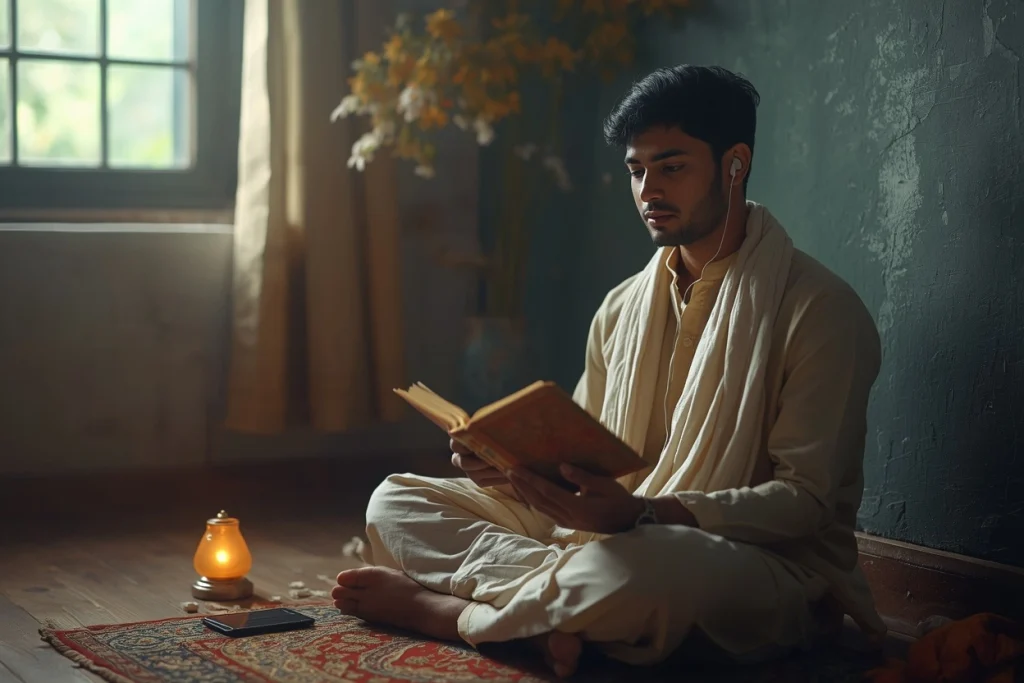
Yes, as long as the teaching is live and someone corrects you. Pronunciation is the part people most often get wrong when they learn alone, because nobody tells them. At Adi Sanaskar every online session runs live, so you chant, get corrected and ask questions in real time. In addition, you send a voice recording every week for your teacher to correct, and you receive exclusive mantra audio notebooks: audio files built for chanting practice, so you can repeat a mantra until the rhythm is right without waiting for the next class.
At the diploma level you also learn to read the panjika. Our Bengali panjika page shows the daily tithi and nakshatra, so it’s a good place to practise. If you want a personal reading of a muhurta or horoscope, our astrology consultation covers that.
Why does real puja practice matter?
Reading a mantra and conducting a puja are different skills, and only practice builds the second one. That’s why Adi Sanaskar moves you through five stages:
- Learn: live classes, Bengali handbooks and mantra audio.
- Watch: you attend real pujas with a senior purohit and see how timing, ritual and the family come together.
- Assist: you prepare the samagri, set up the seat and chant parts of the puja.
- Lead with a mentor: you conduct the puja while your mentor stays close and steps in only when needed.
- Take bookings: after you complete the course, you can join the Adi Sanaskar platform as a verified purohit, depending on bookings and your skill.
| Course | Pujas watched | Assisted | Led |
|---|---|---|---|
| Adi Pujari | 2 | 0 | 0 |
| Adi Purohit | 10 | 10 | 5 |
| Adi Acharya | 10 | 20 | 15 |
Acharya students also complete an internship through one full Durga Puja season, the busiest and most demanding stretch of the ritual calendar.
Our teachers perform pujas for families through our purohit booking in Kolkata service. That’s where you observe and assist, so you learn on real occasions with real families.
How do the student portal and exams work?
Once you register, you get a personal student portal. It holds everything in one place:
| In the portal | What it gives you |
|---|---|
| Class rules | The code of conduct for your batch |
| Attendance records | A clear view of the classes you’ve attended |
| Study notes | Notes for each class |
| Exclusive video links | Videos available only to enrolled students |

You sit time-based exams securely on the platform, so you don’t need to travel for them. Each level also adds oral and practical assessment: a mock puja and written test at the basic level, and a final practical exam with an interview, or an oral exam before the gurus, at higher levels. An online exam alone cannot judge whether you can conduct a puja, so we pair it with practical assessment.
What is a purohit certificate worth? Purohit certification in West Bengal
A purohit training school’s certificate shows what you studied, but it is not a licence to practise. At Adi Sanaskar you earn an official Adi Sanaskar certificate after you pass the exams: a certificate for Adi Pujari, a diploma for Adi Purohit, and an advanced diploma with the title Acharya for Adi Acharya. Each one carries a QR code, so a family, a committee or another purohit can scan it and confirm it’s genuine.

We want to be clear about what it is not. Adi Sanaskar issues the certificate, and no government board issues or recognises it. In West Bengal, families judge a purohit mostly by skill and reputation, so treat any purohit certification as supporting evidence, not as proof of ability. In practice, a purohit’s standing comes from demonstrated skill, a guru’s endorsement and the trust of the families he serves. So the certificate documents your training and makes it verifiable, but it doesn’t replace those things.
How to verify any school’s certificate
Before you pay any school, check three things:
- Ask who issues the certificate and whether anyone can verify it online (a QR code or a public lookup).
- Ask whether any government body recognises it, and get the answer in writing.
- Be cautious about claims like “valid for all employment” or specific salary promises with no evidence.
How much does purohit training cost, and how do you enrol?
Fees by course
| Course | Total fee | Admission fee | Instalments | Women (50% off) |
|---|---|---|---|---|
| Adi Pujari (3 months) | ₹5,999 | ₹2,499 | ₹1,750 × 2 | ₹2,999 |
| Adi Purohit (9 months) | ₹9,999 | ₹1,999 | ₹1,000 × 8 | ₹4,999 |
| Adi Acharya (18 months) | ₹19,999 | ₹1,999 | ₹1,000 × 18 | ₹9,999 |
Fees last verified: November 2026. Check the purohit training in Kolkata course page for the latest figures.
The fee covers live classes, study material, the Bengali PDF handbook, mantra audio notebooks, student portal access, weekly voice feedback, practice at real pujas, the online exam and the certificate.
Refund and cancellation rules
| Situation | What happens |
|---|---|
| Verification finds you don’t meet eligibility | We deduct a 5% admin charge and refund the rest |
| You cancel within 7 days of class start | We deduct 10% and refund the rest |
| You cancel after 7 days | No refund |
| Late instalment | Due by the 7th each month; ₹10 per extra day after that |
Admission steps
- Choose a course and a mode (online, offline or combo), then register online or start on WhatsApp.
- Pay by UPI, card or net banking, either in full or as the first instalment.
- Take a short verification call and send one supporting document on WhatsApp.
- Finally, join the class WhatsApp group and collect your batch schedule and portal access.
Ready to start? Enrol online or ask a question on WhatsApp.
How do you choose a purohit training school or Hindu priest training institute? Eight questions to ask
Use these with any school, including ours:
- Who teaches? Ask for names and years of experience, and whether they perform pujas themselves.
- Is the teaching live? Recorded lectures can’t correct your chanting.
- How many real pujas will I watch, assist and lead? A vague answer is a warning sign.
- Which language and which tradition? A Bengali household puja differs from a north-Indian one in its panchali, alpona and rites.
- Who issues the certificate, and can anyone verify it?
- What is the total cost, and what is the refund policy? Get it in writing.
- Does evidence back the job or salary claims? No school can guarantee work.
- Can I speak to a current or past student?
Who can join the purohit training?
At Adi Sanaskar, the admission conditions are the same for all three courses:
| Requirement | Details |
|---|---|
| Men | Brahmin by birth |
| Women | Brahmin by birth, or married into a Brahmin family |
| Age | Minimum 16; under 18 needs a parent or guardian’s consent |
| Language | Able to read and write Bengali |
| Documents | A gotra declaration and one supporting document: your family purohit’s details, or a marriage certificate for married women |
| Interview | A short phone interview of about 5 minutes before we confirm your seat |
This is our institution’s own admission rule, based on the tradition we teach. Other schools set different conditions, so read them before you apply anywhere.
Women learners: women can join any course and pay half the fee. Whether you want to perform rituals for your own family or serve others, the same path and the same practice requirements apply.

What can you realistically expect after training?
Be realistic about this: no school can promise you a job, and we don’t. Work depends on bookings and your skill. After you complete a course, you can join the Adi Sanaskar platform as a verified purohit, and Acharya graduates can take senior bookings such as weddings and large pujas. We give you the earnings-sharing terms in writing when you enrol.
In practice, a purohit’s income comes from dakshina for each puja and grows with reputation. Demand peaks around Durga Puja, Kali Puja, Saraswati Puja and the wedding season, so a family that trusts you tends to call you again for annaprashan, griha pravesh and later rites. That’s why the practice stage matters: the families you serve while training are where your future bookings come from.
Who are the teachers in Priest Course?
| Teacher | Location | Experience | Expertise |
|---|---|---|---|
| Nimai Mukherjee | Sonarpur, West Bengal | 16+ years | Bhagavad Gita path, Chandi path, deity installation (pratishtha), all Hindu pujas |
| Debabrata Chakraborty | South 24 Parganas, West Bengal | 16+ years | Bhagavad Gita path, Chandi path, deity worship and puja, all Hindu rituals |
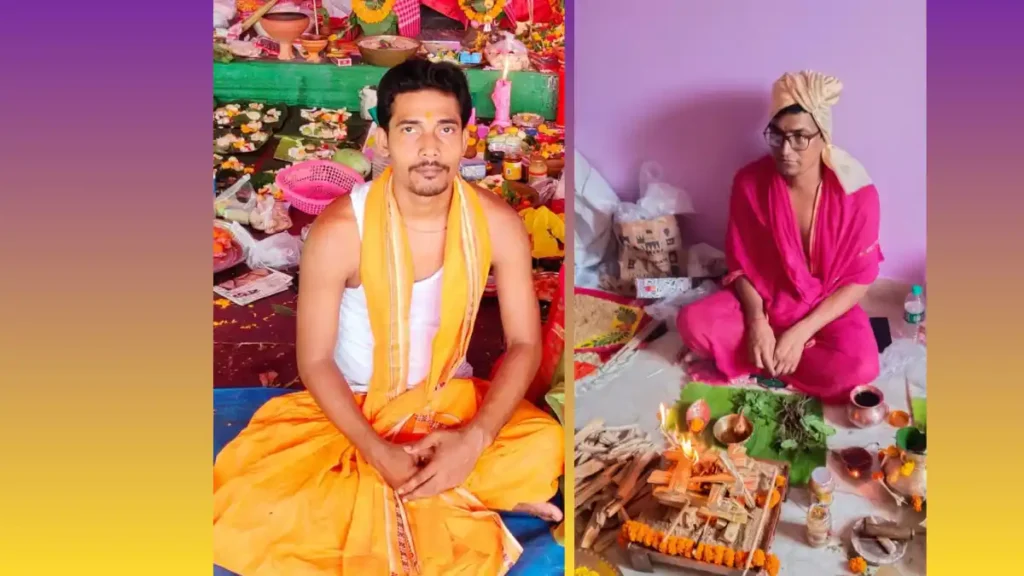
Both perform pujas for families through our booking service, so they teach what they do every week.
Frequently asked questions
What is a purohit training school?
Where can I get purohit training in Kolkata?
Can I learn to be a purohit online?
How long does it take to become a purohit?
How much does purohit training cost?
Is a purohit training school certificate valid?
Can women join purohit training?
What is karmakanda?
Will I get a job after the course?
What happens after I pay?
More questions? Read our FAQ page or contact us.
Start the right way
If you are comparing every purohit training school in Kolkata, message us on WhatsApp and tell us your goal. We will suggest which of the three courses and which mode fits you, and we will tell you honestly if another route suits you better. You can also read the full purohit training in Kolkata course page.
About Adi Sanaskar: Adi Sanaskar is a Kolkata-based platform for purohit booking, purohit training and Bhagavad Gita courses across West Bengal. Contact: +91 85839 37114, adisanaskar@gmail.com.


